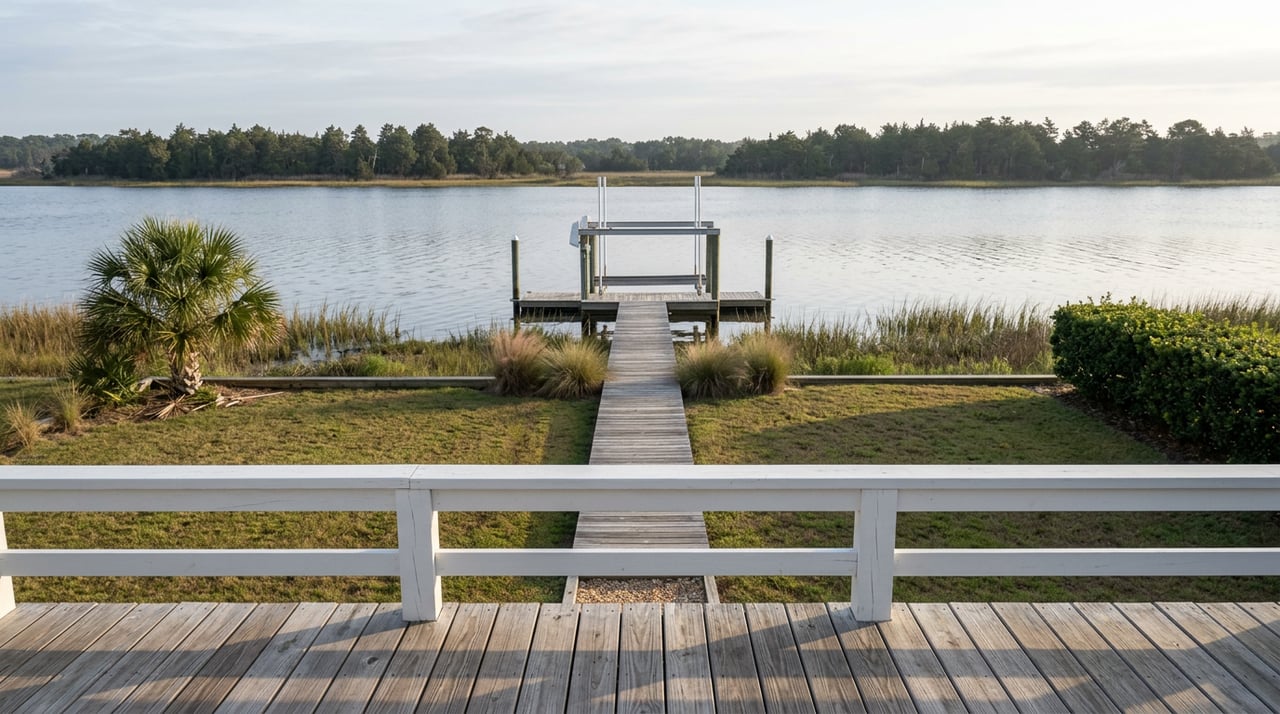
Two houses on the same stretch of the White Oak River can look nearly identical from a boat. Same weathered gray decking, same boat lift bolted to the same style piling, same 40-foot walk out to open water. One of those docks is a legal fixture that transfers cleanly with the sale. The other is a liability the new owner inherits the moment the deed records. Nothing in the listing photos tells you which is which.
That gap has nothing to do with build quality or how old the structure looks. It comes down to paperwork most buyers never think to ask for, and it is the real difference between what a Swansboro waterfront listing promises and what a buyer actually owns after closing.
A Dock Is a Permission, Not a Possession
The instinct when touring a waterfront home is to treat the dock the way you'd treat the roof or the HVAC system: it's there, it works, it conveys with the sale. Docks don't work that way under North Carolina's coastal rules.
Every dock, pier, boat lift, or bulkhead repair on tidal water in Carteret County falls under the Coastal Area Management Act, administered by the state's Division of Coastal Management. The structure itself isn't what makes it legal. The permit behind it is. A common assumption among buyers and even some longtime owners is that a dock built decades ago is automatically grandfathered in simply because it has survived that long. It isn't. Grandfathered status is a specific legal finding, not something that accrues with age. If a previous owner extended a pier, added a lift, or rebuilt a bulkhead without ever filing for a permit, the state can require the new owner to remove it, regardless of who built it or when.
That risk doesn't show up on a home inspection in the way a cracked foundation does. It shows up months after closing, when a routine repair or a neighbor's complaint triggers a compliance review and the buyer discovers they've inherited a problem instead of an asset.
Why the Same Rule Book Produces Different Docks Lot to Lot
Buyers touring Swansboro waterfront often use the neighbor's dock as an informal benchmark, on the theory that if one property on Halls Creek or Foster Creek got a 200-foot pier approved, a similar lot nearby should get something comparable. Shoreline shape and channel width make that comparison unreliable.
State general-permit standards require a dock to stay at least 15 feet from the projection of the adjacent property's riparian line into the water, and cap total projection at roughly a quarter of the waterbody's width. On a wide reach of the Intracoastal Waterway near Deer Island Harbor, that math allows a longer structure. On a narrow finger creek, the same formula can cut a proposed dock down considerably, even if the lot next door has something twice as long. Platform size is capped as well, generally around 800 square feet for a single-family pier and less for a sheltered floating dock, and any structure near submerged aquatic vegetation has to either avoid shading it entirely or sit elevated at least 3 feet above mean high water with widely spaced decking to let light through.
None of this is visible by looking at a listing photo or even standing on the existing dock. It's determined by the lot's specific shoreline geometry, and it's why a buyer's due diligence has to include the property's own permit file, not a visual comparison to what's next door.
| Permit Type | Covers | Typical Fee | Processing Time |
|---|---|---|---|
| CAMA General Permit | Standard residential docks, piers, boat lifts, bulkhead repair | $100–$400 | 14–30 days |
| CAMA Major Permit | Commercial work, marinas, or projects affecting a designated Area of Environmental Concern | $475 and up | Longer review, case by case |
What the Swansboro "Waterfront Median" Doesn't Tell You
If you've already looked at pricing, you've probably seen a few different numbers and assumed one of them was outdated. As of August 2026, the town-wide median list price for Swansboro homes sat at $445,000, with a typical 60 days on market. Narrow that same month to the active waterfront-specific listings, just 12 homes at the time, and the median list price drops to $392,000 with homes moving faster, at a median of 46 days. Look instead at closed sales over the trailing 12 months and the median comes in at $385,000, up 10 percent year over year.
Those three numbers aren't measuring the same thing, and the gap matters more than any single figure. A townwide median blends inland new construction with high-end deepwater estates. A waterfront-specific snapshot of a dozen active listings can just as easily include a small canal lot with no legal dock at all as it can a property with a fully permitted 200-foot pier. The word "waterfront" on a listing doesn't tell you which one you're looking at, and neither does the price. Two homes can carry nearly identical price tags while one comes with a compliant, insurable dock and the other comes with a structure that may need to be torn down before it can be rebuilt.
The price on a waterfront listing describes the view. It does not describe what you're legally allowed to do with the water in front of it.
That's the number buyers should be pricing in, and it isn't one a portal median will ever show you.
The Verification List Before You Write an Offer
Before a waterfront offer goes in on a Swansboro property, ask the listing side for documentation on these specific points:
- The most recent CAMA permit decision letter for the dock, lift, or bulkhead, not just a builder's original permit from years ago if the structure has since been repaired or extended
- Whether any part of the dock crosses a designated Primary Nursery Area or an active shellfish lease, which requires separate notification to the leaseholder
- Whether the structure sits near submerged aquatic vegetation and, if so, whether it meets the elevation and spacing rules that apply in that case
- Survey documentation showing the riparian property line projection into the water, especially on irregular shorelines near canal ends or narrow creeks
- Any history of storm damage repair, since those permits are processed under an expedited track and may carry different conditions than a standard new build
None of these questions are unusual to ask. They're rarely asked before an offer is written, which is exactly when they carry the most leverage.
Timing Matters More Than Buyers Expect
A standard CAMA general permit for a residential dock takes 14 to 30 days from filing to issuance. If a structure needs storm-damage repair rather than a fresh build, that timeline can be expedited to 7 to 10 days. Buyers who assume they can simply fix a permit gap after closing during a slow season are often surprised that the standard track alone can eat a month, and that's before accounting for any additional review triggered by a shellfish lease or an environmental concern area.
There's a second layer worth knowing about before you assume CAMA approval is the finish line. Docks in navigable waters can also fall under U.S. Army Corps of Engineers jurisdiction, which operates on its own separate authorization track. A state permit doesn't automatically clear the federal one, and a buyer planning any change to an existing structure should confirm both before assuming a project can move forward on the timeline they have in mind.
A Few Questions Buyers Ask Once They Understand This
If a dock doesn't have a permit on file, does that kill the sale? Not necessarily. It means the buyer needs to know that risk exists before closing, factor it into negotiations, and decide whether to require the seller to resolve it or adjust price to reflect the cost of doing so later.
Can I just match what the house next door has? Not reliably. Setback and projection limits are calculated from your own property's riparian line and the specific width of the water in front of it, so a neighbor's approved dock length isn't a guarantee for your lot.
How fast could I get a new dock built after closing if the current one isn't usable? Budget for the standard 14 to 30 day state review at minimum, longer if the site involves a shellfish lease, protected vegetation, or federal jurisdiction, and plan any summer boating season around that window rather than around closing day.
A dock is one of the few features on a waterfront listing where the price tag and the paperwork can tell two completely different stories. If you're comparing properties along the White Oak River or the Intracoastal side of Swansboro right now, our team can help you pull the permit history before you write an offer instead of after. And if this exercise has you wondering what your own dock's compliance record might mean for your home's value, NC Coastal Team's Get Your Home Value tool is a reasonable place to start that conversation too.
