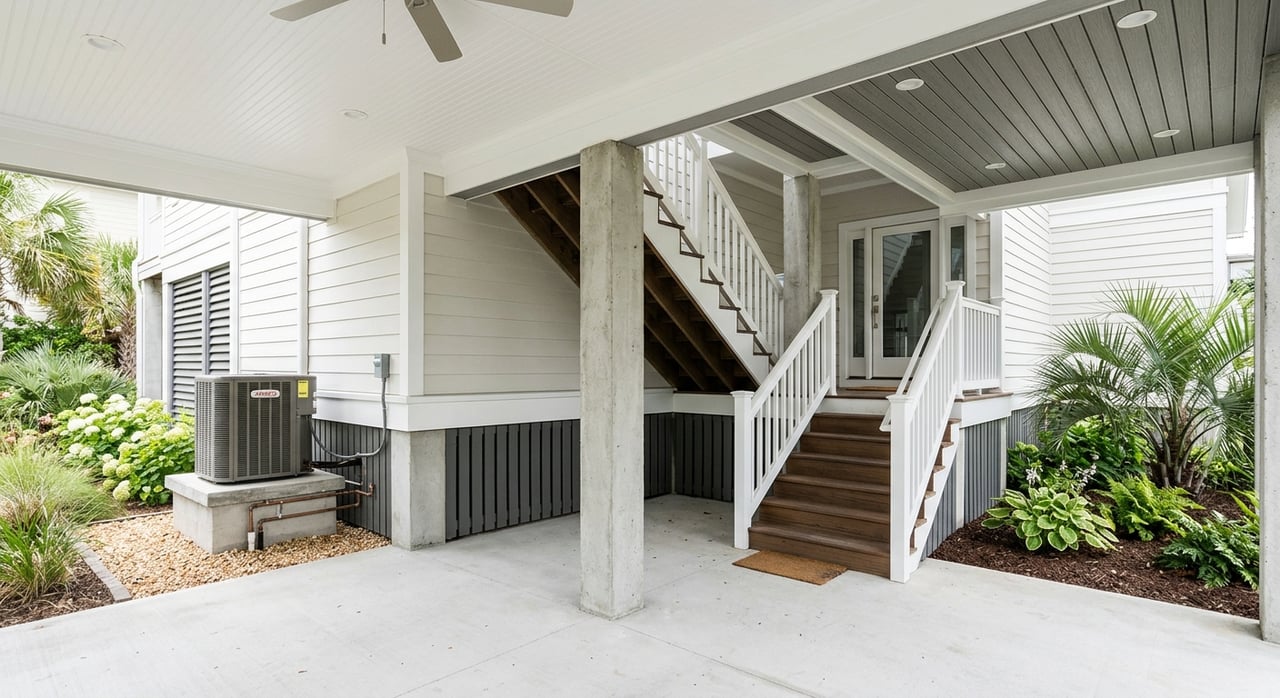
Buying near the water in New Bern can feel exciting right up until you start hearing terms like flood zone, elevation certificate, named-storm deductible, and coastal wind policy. If that sounds overwhelming, you are not alone. The good news is that once you understand how flood maps, insurance rules, and lender requirements fit together, you can evaluate a property with much more confidence. Let’s dive in.
Why flood risk matters in New Bern
New Bern sits in Craven County, where flooding can come from more than one source. According to Craven County flood hazard information, the main drivers include storm surge moving inland through Pamlico Sound into the Neuse and Trent Rivers, along with river flooding caused by heavy rainfall.
That matters because a home does not have to sit right on the water to face flood exposure. In this area, both coastal and inland flood patterns can affect how a property is mapped, how insurance is priced, and whether your lender will require coverage.
There is one helpful local benefit to know about. Craven County participates in the National Flood Insurance Program, and the county says eligible property owners currently receive a 10% reduction in flood insurance premiums because the county has a Class 8 rating in the Community Rating System.
What flood zones actually mean
Flood zones are FEMA map designations that show the estimated level of flood risk for a property. These zones are important because they can affect lender requirements, insurance costs, and sometimes even your comfort level as a buyer.
FEMA identifies high-risk Special Flood Hazard Areas, often called SFHAs, as Zones A, AE, A1-A30, AO, AH, AR, V, VE, and V1-V30. FEMA also uses lower- or moderate-risk labels such as B, C, and X, while D means the flood risk is undetermined, based on FEMA flood zone guidance.
A common mistake is assuming an X zone means there is no flood risk. That is not the case. FEMA notes that flood claims still happen outside the highest-risk zones, so a lower-risk map label should be treated as a data point, not a guarantee.
Where to check official flood maps
When you are serious about a home, always verify the flood zone using official sources. Listing details can be helpful, but they should not replace direct map research.
You can start with these resources:
- Search the property address in the FEMA Flood Map Service Center, which is the official public source for NFIP flood hazard information.
- Review Craven County flood resources, which connect you to local and state flood mapping tools and note that flood studies and Flood Insurance Rate Maps are available through the Planning Department.
- Use the North Carolina Floodplain Mapping Program for property risk tools, insurance cost tools, and map update information.
If you are buying from out of town, this step is especially important. A quick address search can help you understand whether a property falls in a high-risk area before you get too far into the process.
How flood insurance works
Flood insurance is usually separate from your homeowners insurance policy. Standard homeowners coverage generally does not cover flood damage, according to FEMA flood insurance guidance.
If a home is in a high-risk flood area and you have a mortgage from a government-backed lender, flood insurance is generally required. FEMA says the minimum required coverage is usually the lesser of the loan balance, the building’s replacement cost excluding land, or the maximum available NFIP coverage. Even outside a high-risk zone, some lenders can still require flood coverage.
Timing matters too. FEMA says NFIP policies generally have a 30-day waiting period before coverage begins, unless the policy is required by a lender or tied to a qualifying map change. That means it is smart to start the insurance conversation early instead of waiting until the last minute.
What flood premiums may look like
There is no single New Bern flood insurance price. FEMA now rates properties individually, and premium depends on factors like where the property is built, how it is built, replacement cost, elevation, flood type, distance to water, and certain mitigation features, based on FEMA’s Risk Rating information.
For a rough national benchmark, FEMA reports that for single-family homes, 37% of policies nationwide are below $1,000 per year and 32% fall between $1,000 and $2,000 per year. That is useful as a ballpark only. It is not a quote for New Bern, and some homes in higher-risk zones may cost significantly more.
If you are buying a condo, your insurance setup may look different. FEMA materials explain that the association may already carry a building policy, while you may need contents or interior coverage to fill gaps. For commercial or non-residential property, NFIP coverage limits can go up to $500,000 for the building and $500,000 for contents, which often means higher premiums.
Why elevation certificates matter
An elevation certificate is a document that records a building’s first-floor height and other features tied to flood risk. According to FloodSmart’s elevation certificate guidance, most homeowners do not need one, but many properties in Zone A or Zone V may.
This document can matter because it may help confirm how a property should be rated for insurance. It can also become important if you are trying to challenge the current flood map designation or document that the structure sits higher than the map suggests.
If you are considering a property in or near a high-risk zone, ask whether an elevation certificate is already on file. FloodSmart says your first stop should be the local floodplain manager or permitting office. If none exists, a surveyor, engineer, or architect can prepare one.
Can a flood zone change?
Yes, in some cases it can. FEMA says a property owner may be able to request a Letter of Map Amendment (LOMA) or a Letter of Map Revision Based on Fill (LOMR-F) if a structure is shown in a Special Flood Hazard Area but is actually on naturally high ground or has been elevated by fill, according to FEMA’s flood zone change information.
If that request is approved, the owner may no longer be required to carry flood insurance for that structure. That does not automatically mean carrying flood coverage is a bad idea, but it can affect lender rules and ownership costs.
This is why buyers should not stop at the current map label. It is worth asking whether there is an existing elevation certificate, whether a map change has already been requested, and whether state or county map updates are pending.
Do you also need wind and hail coverage?
In coastal North Carolina, flood insurance is only one part of the picture. The North Carolina Department of Insurance says windstorm and hail coverage may be excluded from a primary homeowners policy in some coastal areas, which means you may need a separate policy.
When that happens, the coverage is often written through the North Carolina Insurance Underwriting Association, also called the Coastal Property Insurance Pool. Craven County is one of the eligible coastal counties.
You should also pay close attention to deductibles. NC DOI says these policies may include separate deductibles, including a named-storm deductible that applies during a named-storm watch or warning period and for 24 hours after the last warning ends. These deductibles are often a percentage of Coverage A or Coverage C, so the out-of-pocket amount can be much larger than a flat deductible.
What buyers should ask before making an offer
Insurance and flood mapping questions are easiest to handle before you are under pressure. A few early conversations can help you avoid surprises later in the contract process.
Use this checklist as a starting point:
- Check the exact property address in the FEMA map search portal and the North Carolina flood mapping portal.
- Ask the seller or county whether an elevation certificate is already on file.
- Ask your lender whether the property is in a Special Flood Hazard Area and what amount of flood coverage will be required.
- Ask your insurance agent whether windstorm and hail are included in the homeowners policy or excluded.
- If wind is excluded, ask whether a separate coastal wind policy may be needed.
- Request quotes early enough to account for the NFIP waiting period if the policy is not being required by the lender.
One more practical tip: FloodSmart notes that NFIP pricing is the same no matter which NFIP carrier or agent writes the policy, so you are usually shopping for service and guidance rather than a different NFIP rate.
A smart way to approach New Bern homes
Flood zones and coastal insurance should not automatically scare you away from a property in New Bern. They should simply be part of your due diligence. The right home may still make excellent sense once you understand the map designation, the likely insurance setup, and the full monthly cost of ownership.
If you are buying from another part of North Carolina or from out of state, having a local team help you connect the dots can save time and stress. Nc Coastal Team can help you navigate the buying process with a practical, informed approach so you can move forward with clarity.
FAQs
What flood zones are considered high risk in New Bern?
- FEMA’s high-risk Special Flood Hazard Areas include Zones A, AE, A1-A30, AO, AH, AR, V, VE, and V1-V30.
Where can you check a New Bern property’s official flood zone?
- You can search the address in the FEMA Flood Map Service Center, review Craven County flood resources, and use the North Carolina Floodplain Mapping Program.
Does homeowners insurance include flood coverage in New Bern?
- No. Standard homeowners insurance usually does not cover flood damage, so flood insurance is typically a separate policy.
When is flood insurance required for a New Bern home purchase?
- Flood insurance is generally required when a property is in a high-risk flood area and the mortgage is from a government-backed lender, though lenders may also require coverage outside those areas.
What is an elevation certificate for a New Bern property?
- It is a document that shows a building’s first-floor height and other flood-related characteristics, and it can affect insurance rating or support a map-change request.
Do New Bern buyers need separate wind and hail coverage?
- Sometimes. In some coastal areas, windstorm and hail may be excluded from a primary homeowners policy, which can mean a separate policy is needed.
